Career
ilmlink: A Starting Point for Students Still Searching for a Career
A career discovery quiz through which students in Pakistan can see how they like to work, and which directions fit, before a profession is chosen.
 Times TX
· 7 min read
Times TX
· 7 min read

Client: Times Consultant
Product: ilmlink
Project: Career discovery product
Industry: Education · Career guidance
Created by: Times TX
Website: https://ilmlink.com/
Introduction
A career is often expected long before it is understood. A subject has to be chosen, a degree has to be named, and a profession has to be explained, while the person making the choice may still be unsure of what actually fits.
ilmlink was created for that moment. A short, science-backed quiz was developed so that students in Pakistan could begin with themselves: with what they enjoy, with what they can do, and with the kinds of work in which they are likely to feel at home. A direction could then be seen more clearly, before a course, a scholarship, or a job was pursued.
The product was introduced in Pakistan by Times Consultant and created by Times TX. It is available at ilmlink.com.

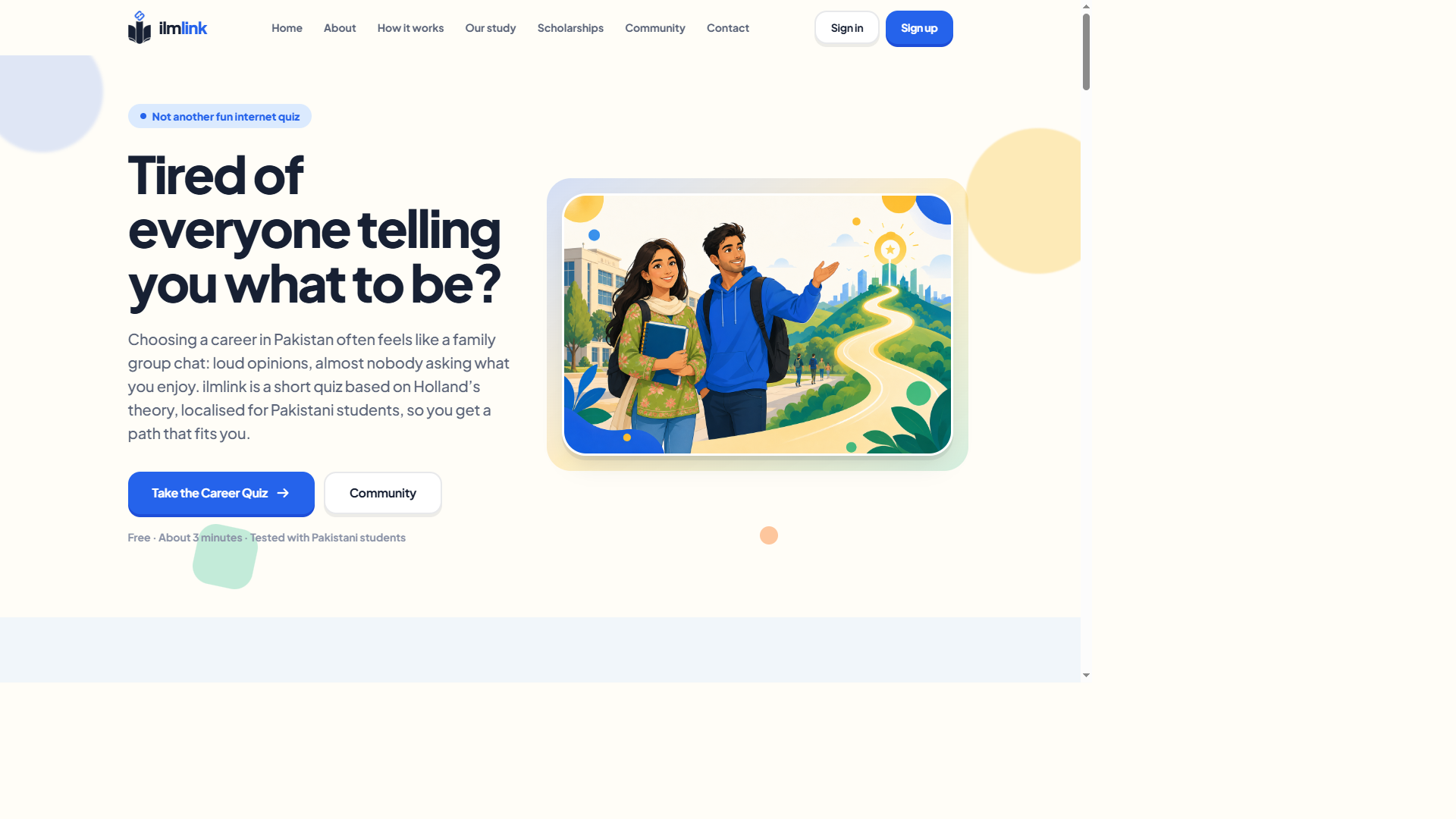
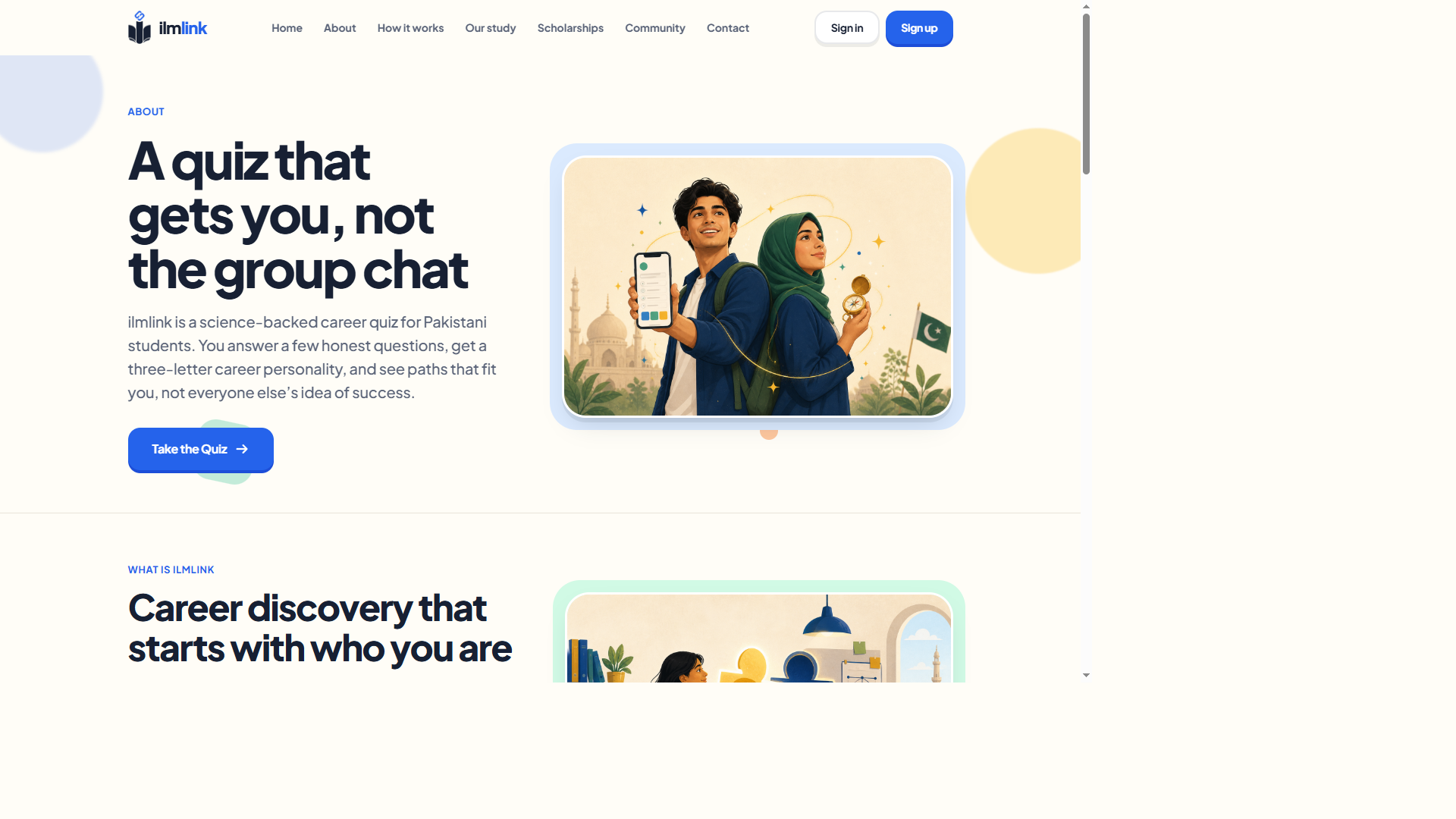
The homepage. A single starting point was given: the career quiz.
About the Client
Times Consultant is an international education consultancy through which students have been supported since 2004. In Pakistan, that support has long included the question of what to study and where. ilmlink was introduced there so that an earlier question could be asked: what kind of work fits this person.
The product itself was created by Times TX, a digital product studio in Hamburg. The quiz, the results, and the student experience around them were designed and built as one career-discovery product.
The Challenge
Advice is rarely scarce. What is often missing is a way to tell which advice belongs to the student. A career may be admired because it is familiar, respected, or already chosen by someone else. The quieter question of fit can be crowded out by well-known paths, among them medicine, engineering, and accountancy.
Without a starting point, that question is difficult to answer. Interests are left vague. Strengths are guessed at. A decision is then made under pressure, or it is postponed, because no direction feels solid enough to be explained.
A tool was needed through which a student who was struggling to find a career could see a pattern in their own interests. That pattern had to be understandable in a few minutes, and careful enough that the result could be trusted.

Why ilmlink was created
ilmlink was created so that the search for a career could begin with the person.
Holland’s Theory of Career Choice was used as the foundation. People and working environments are described in that theory through six broad types, commonly known as RIASEC. The strongest of those types can be read together as a code. The code was treated as a compass: a way of pointing toward environments in which interests and strengths are more likely to thrive. A student was not locked to a single job by it.






The six types were given a face on the website.
The quiz was shaped by the structure of the Self-Directed Search, a widely used form of the same theory: activities, competencies, occupations, and self-estimates. ilmlink was inspired by that structure. It was offered as a guidance tool. It was not published as the official Self-Directed Search, and a certified career counsellor was not replaced by it.
The purpose was practical. Students who felt unsure about what to study, what to pursue, or where they belonged professionally were given a place to begin. A fitting career was understood as more than a list of tasks that can be performed. It was understood as work that suits the way a person thinks, creates, and contributes.
Because the students being served are in Pakistan, the quiz was localised for them and tested with them. An established international framework was examined in a Pakistani undergraduate setting, so that it could be used there with evidence behind it.
What was provided
A free quiz of about three minutes was provided. Thirty-six questions were arranged in four short sections. The quiz was allowed to be started without an account. A free account was asked for only when the results were to be opened. Answers were kept on the device until sign-in.
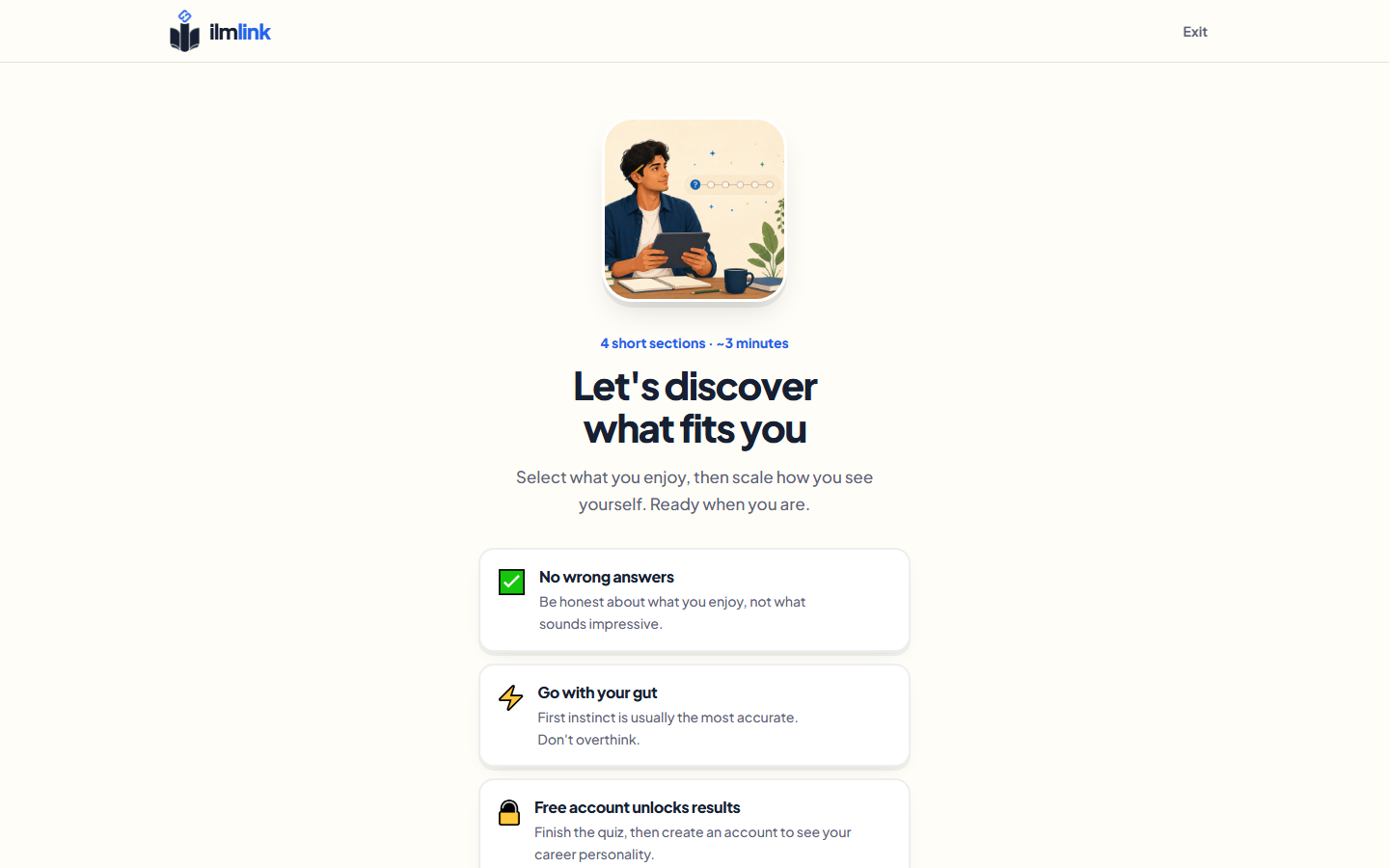
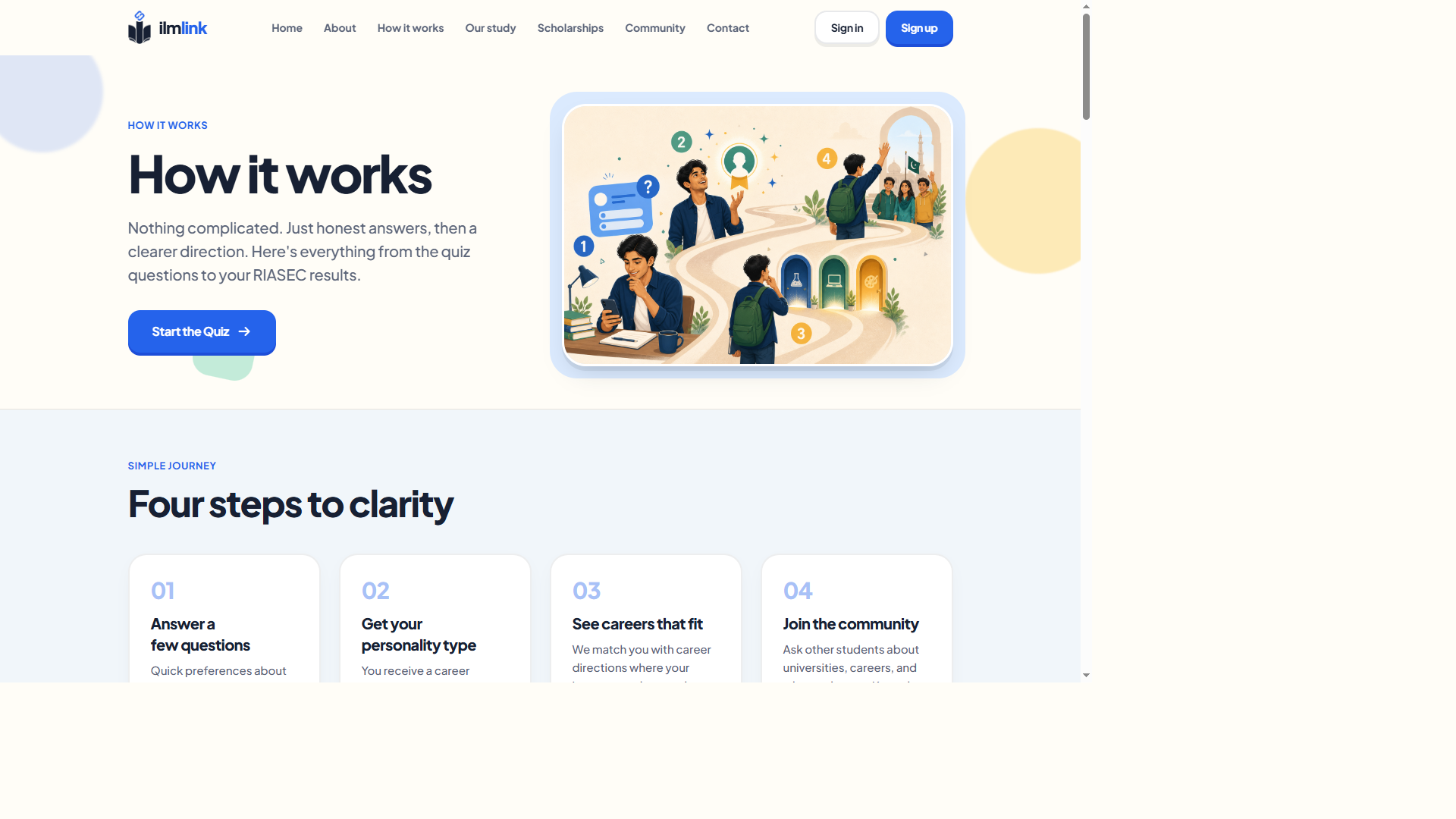
How it works. Four steps were set out before the questions began.
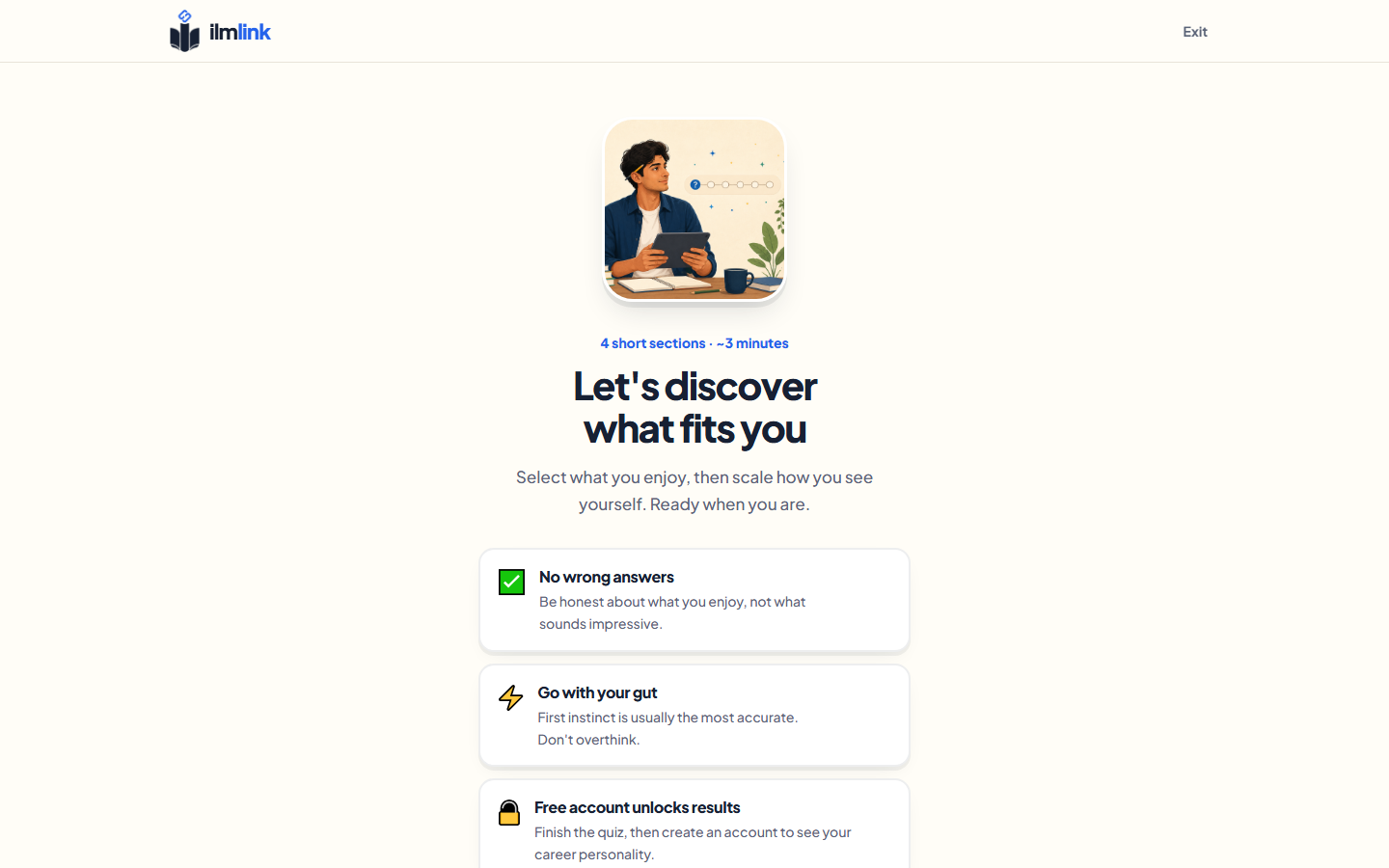
The quiz. It was opened with a short introduction, then the questions.
A three-letter career code was then returned, for example SIA or IRC. Scores across all six types were shown, together with a plain-language profile of how the student likes to work, and with career directions matched to that pattern. The result was meant to be talked about, at home and elsewhere, and to be used as a starting point for further exploration.
Anything beyond that direction was left optional. Scholarships could be reviewed afterwards, and a student community was made available for questions about universities, careers, and what to do next. The purpose of ilmlink remained the direction itself.
Scholarships. Funding and programmes were left as an optional next step.
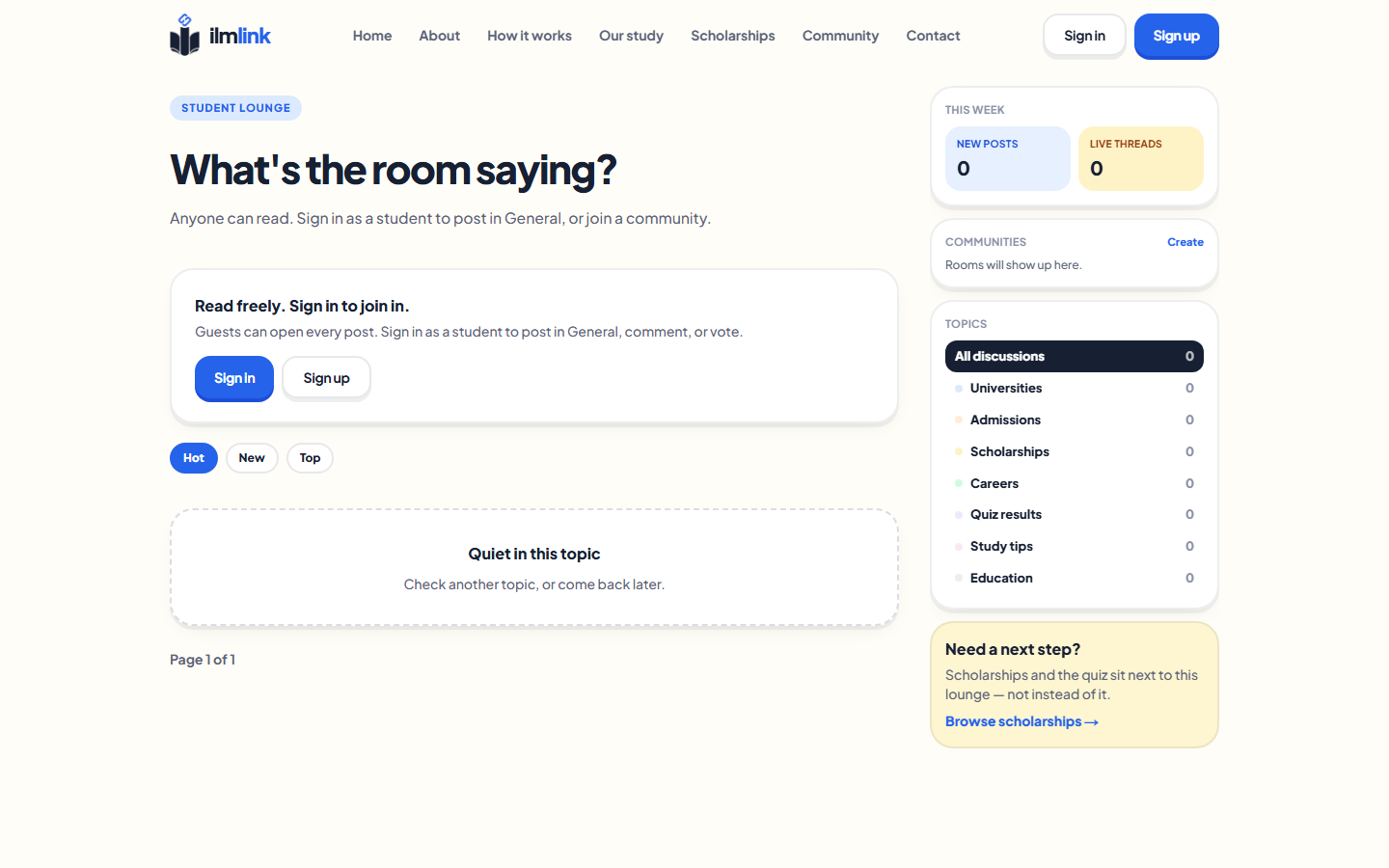
The community. It was left open to read, and a free account was required before a student could post.
The Evidence Behind the Quiz
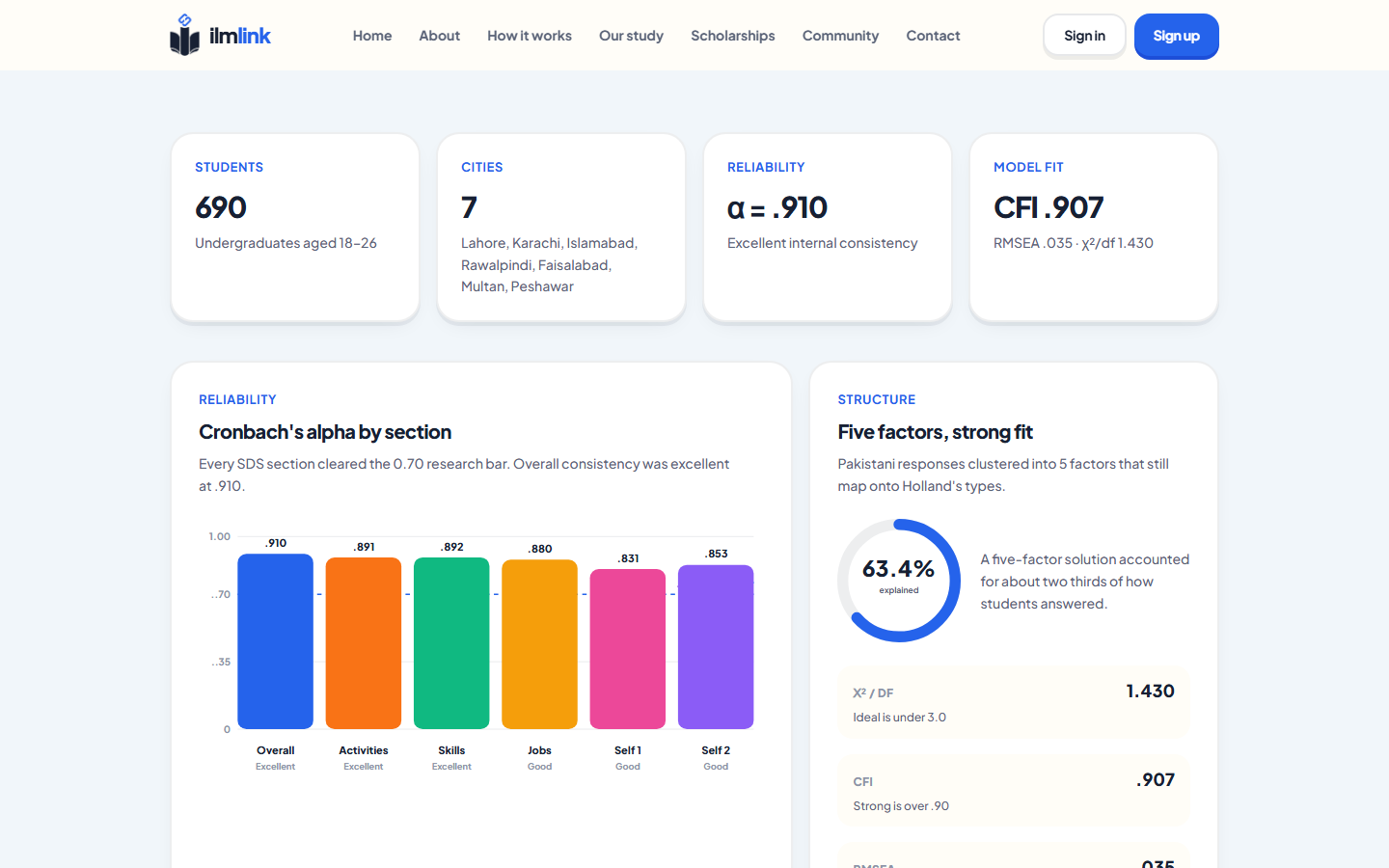
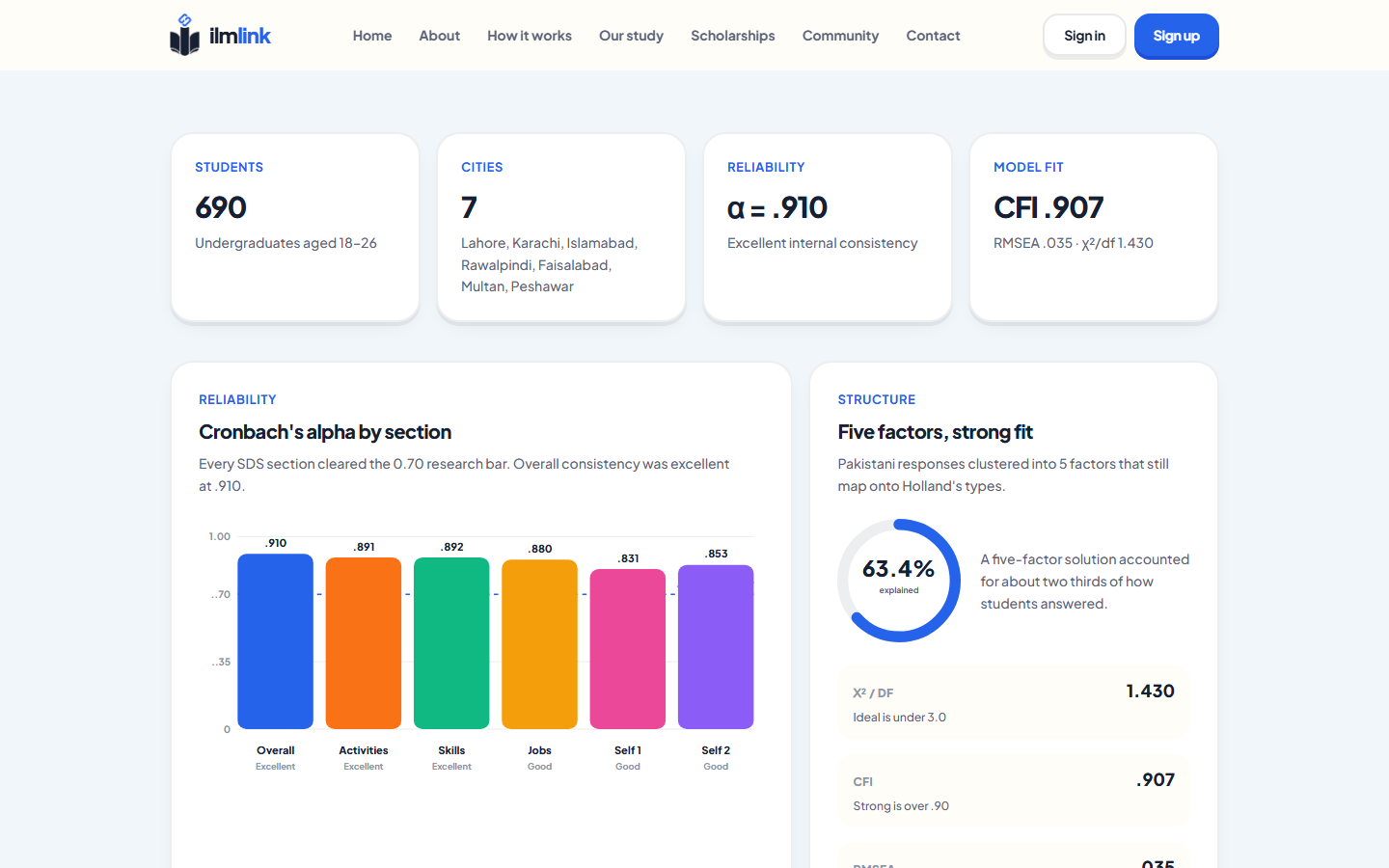
Before ilmlink was offered as guidance for Pakistani students, the measure behind it was studied with them. The psychometric work was led by Times Consultant. The English Self-Directed Search was administered to 690 undergraduates, aged 18 to 26, in Lahore, Karachi, Islamabad, Rawalpindi, Faisalabad, Multan, and Peshawar.
Overall reliability was strong. Cronbach’s alpha was .910. Because of that study, the quiz can be described as tested with Pakistani students. The full account of the work was published with the product, so the basis of the guidance can be read by anyone who wishes to see it.
The study page. The evidence was published with the product.
The Website
The public website was built around the same purpose. Home, about, how it works, the quiz, the study, scholarships, the community, and contact were given their own pages. Illustrations were made for those pages so the product could be recognised at a glance.
Home.
About.
How it works.
The start of the quiz.
Results.
Scholarships.
Community.
The study.
Made for students in Pakistan.
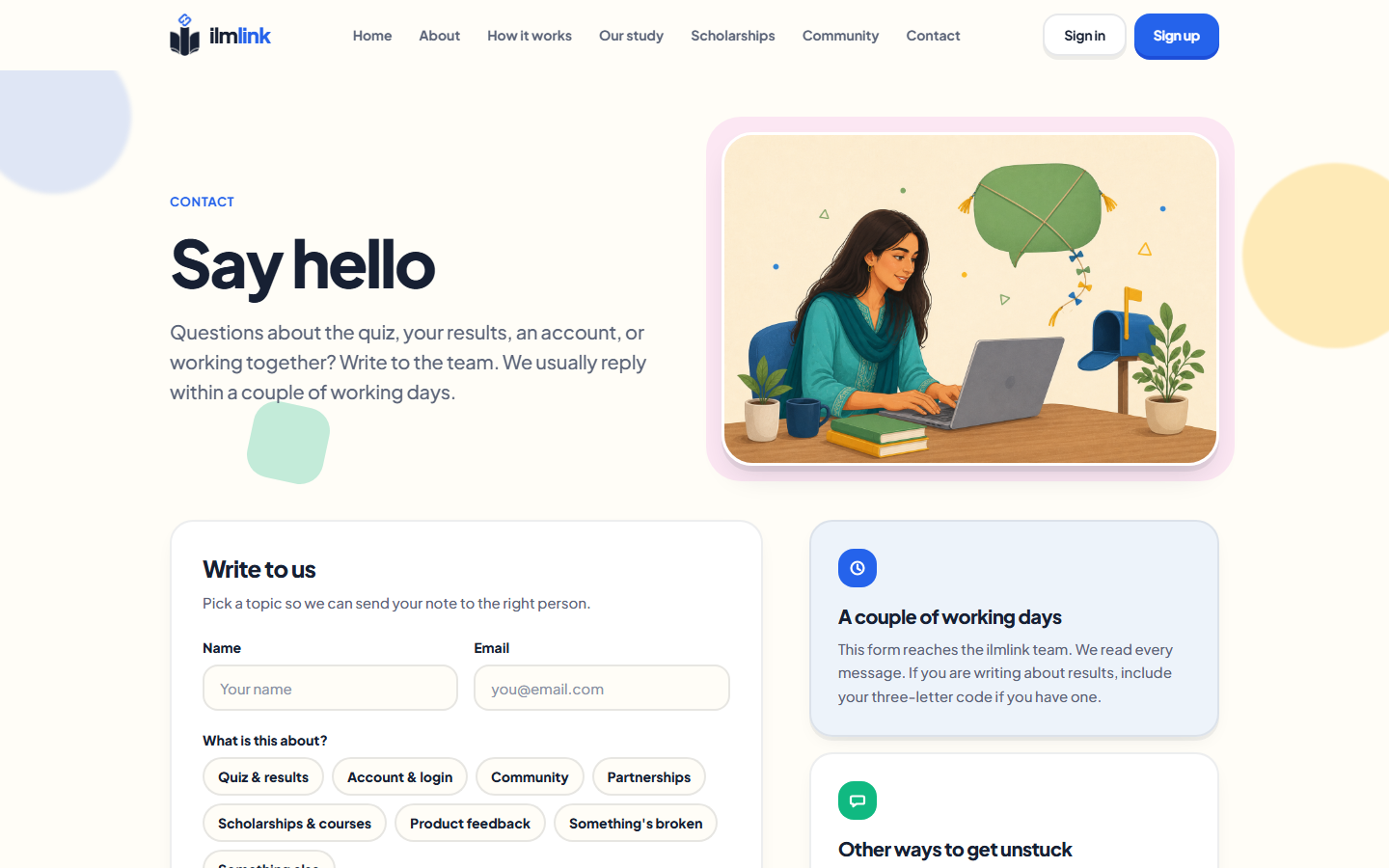
Contact.
Contact. A direct way to write to the team was kept on the site.

Sitemap
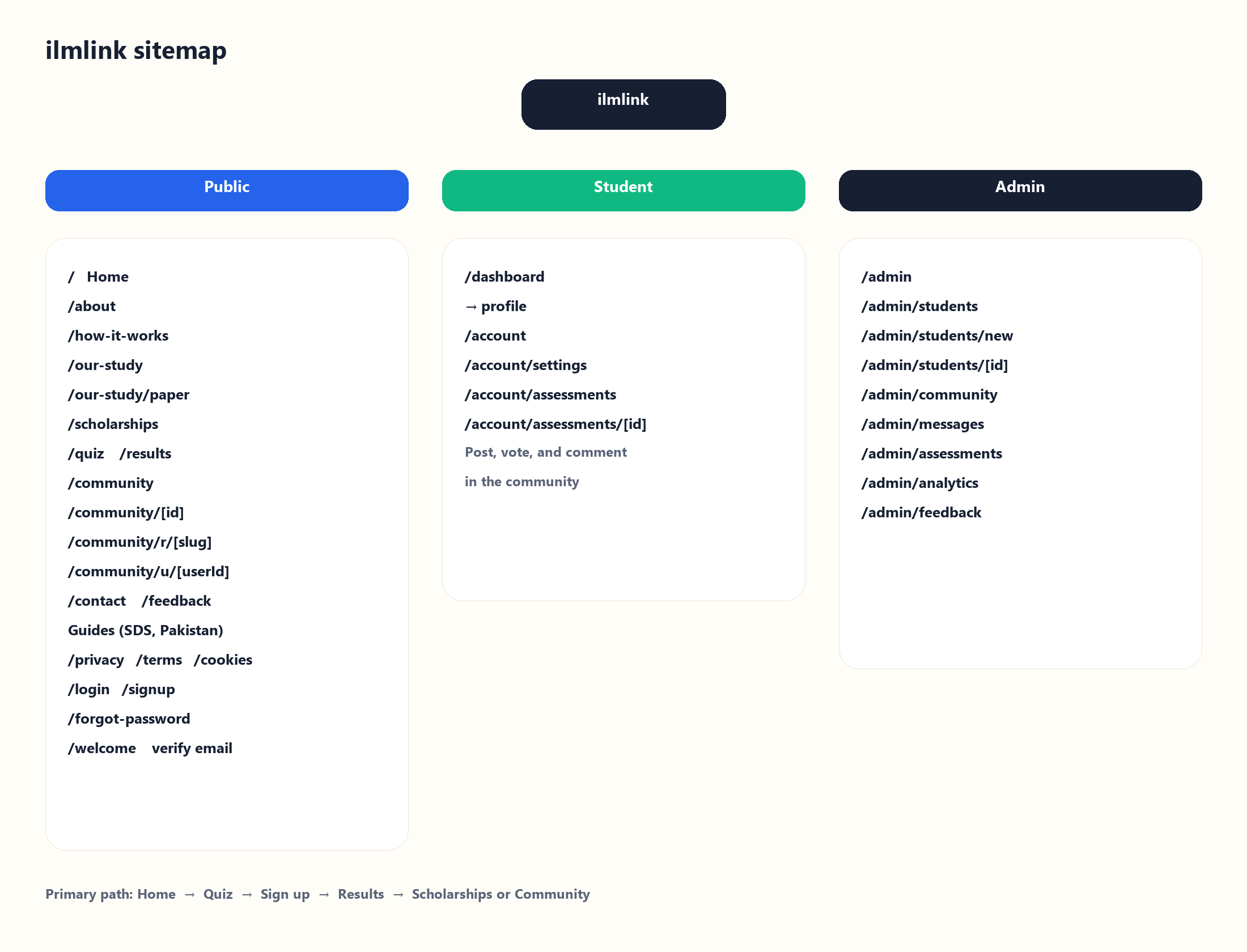
The site was organised into three areas. Public pages could be opened by anyone. A signed-in student area was used for the profile, account, and saved assessments. Administration was kept separate, for students, the community, messages, assessments, analytics, and feedback.
The path that was designed for a new visitor was short: the homepage, the quiz, a free account, the results, and then scholarships or the community if either was wanted.
The ilmlink sitemap. Public pages, the student area, and administration were kept apart.
Outcome
ilmlink was delivered as a career-discovery product for students who are still searching for a direction.
A search that is usually met with other people’s opinions was given another response: a short, evidence-based reading of how a person fits with different kinds of work. A three-letter code, a profile, and careers suited to the way the student likes to work were provided. One correct job was not promised. A clearer place to begin was.
The product was introduced in Pakistan by Times Consultant and created by Times TX. It can be used on its own, at ilmlink.com, whenever a career has not yet been found and a more honest starting point is needed.