Business System
WerkIQ: A Modular Business Platform, Presented as One Connected Journey
A product and website through which people, customers, finance, and operations can be understood, and through which a live demonstration can be requested.
 Times TX
· 6 min read
Times TX
· 6 min read
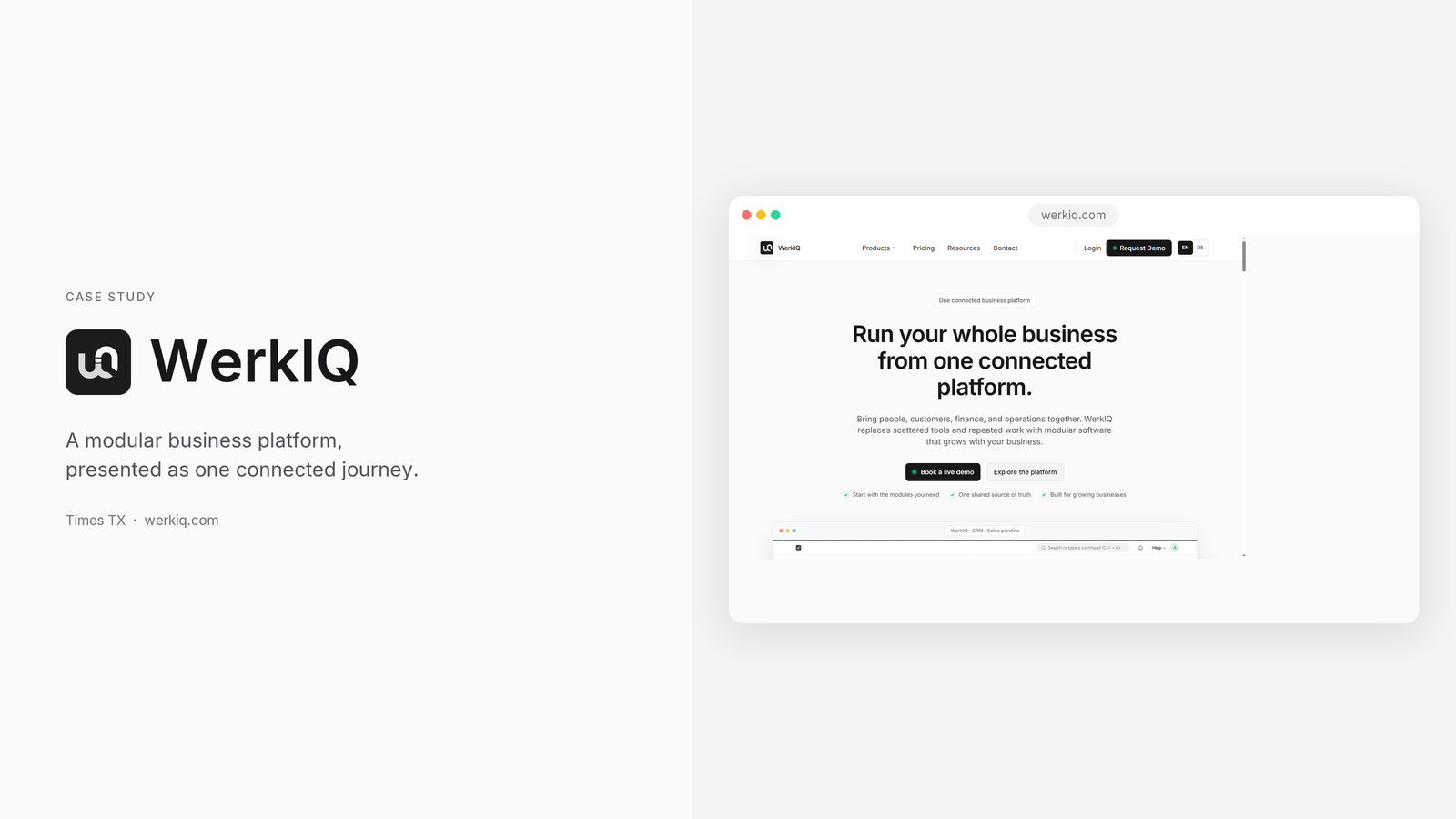
Client: Times TX GmbH
Product: Product positioning, website design, and development
Industry: Business software
Services: Product strategy · Information architecture · UX/UI design · Website development · Bilingual content
Developed by: Times TX
Website: werkiq.com
Introduction
People, customers, money, and day-to-day operations often have to be managed in separate tools. Records are kept in one place, attendance in another, and sales conversations somewhere else. Information then has to be copied from one tool to the next. WerkIQ was developed by Times TX as a modular business platform through which those areas of work can be brought into one workspace. A beginning can be made with the modules that are needed. Further modules can be added as the organisation changes. The website werkiq.com was built so that the platform could be explained before a demonstration is booked. On a first visit, the platform can be understood through the work a team already does.
About the Client
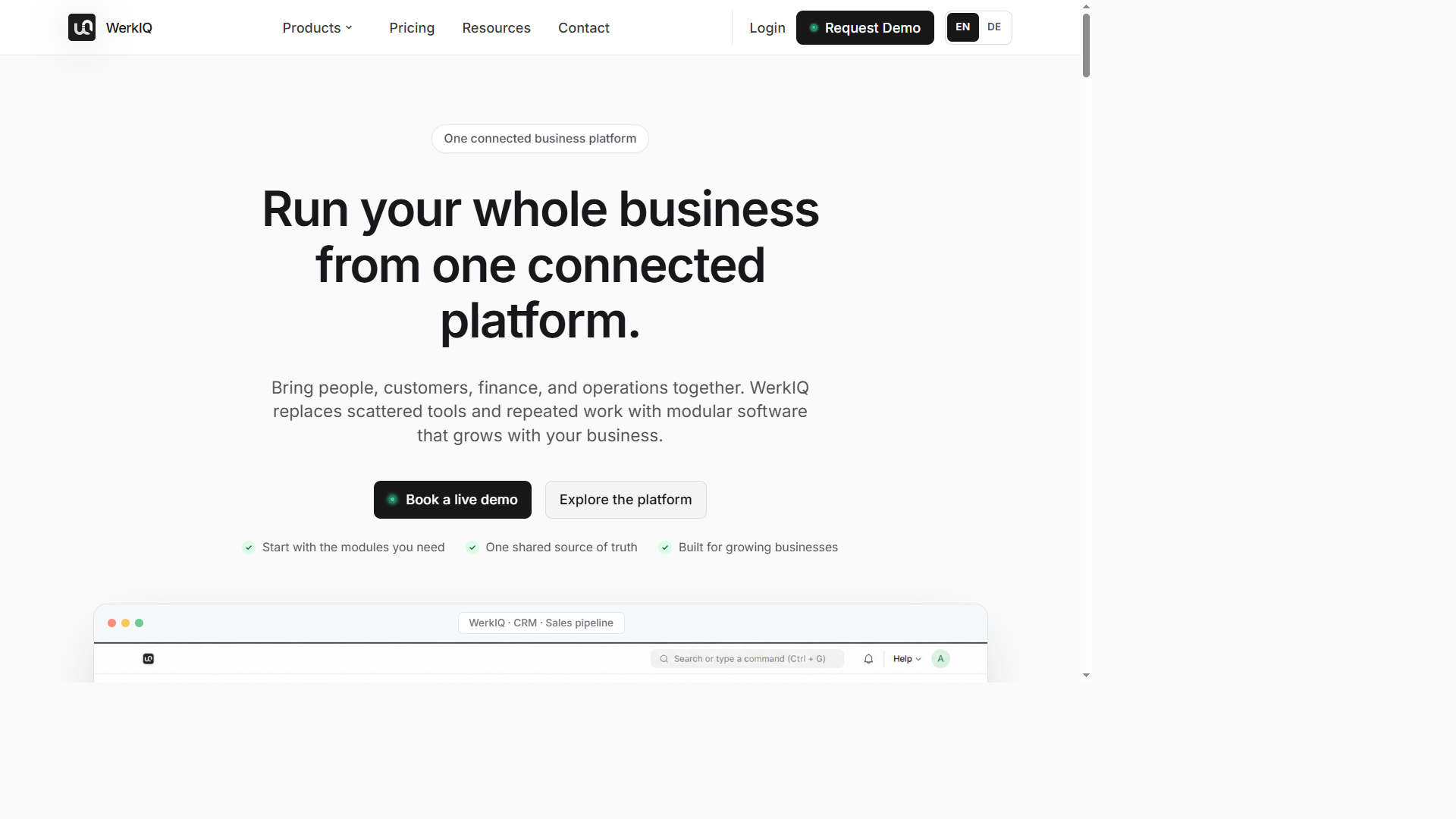
WerkIQ is a product of Times TX GmbH, an IT and software company based in Hamburg, Germany. IT consulting and software services are provided by the company, including digital transformation, software development, digital marketing, and project support. The product was built so that people, customers, finance, and operations can be run from one platform. A record entered in one part of the business can be used in another. The public site was published in English and in German, and a demonstration can be arranged from it.
Who WerkIQ Was Built For
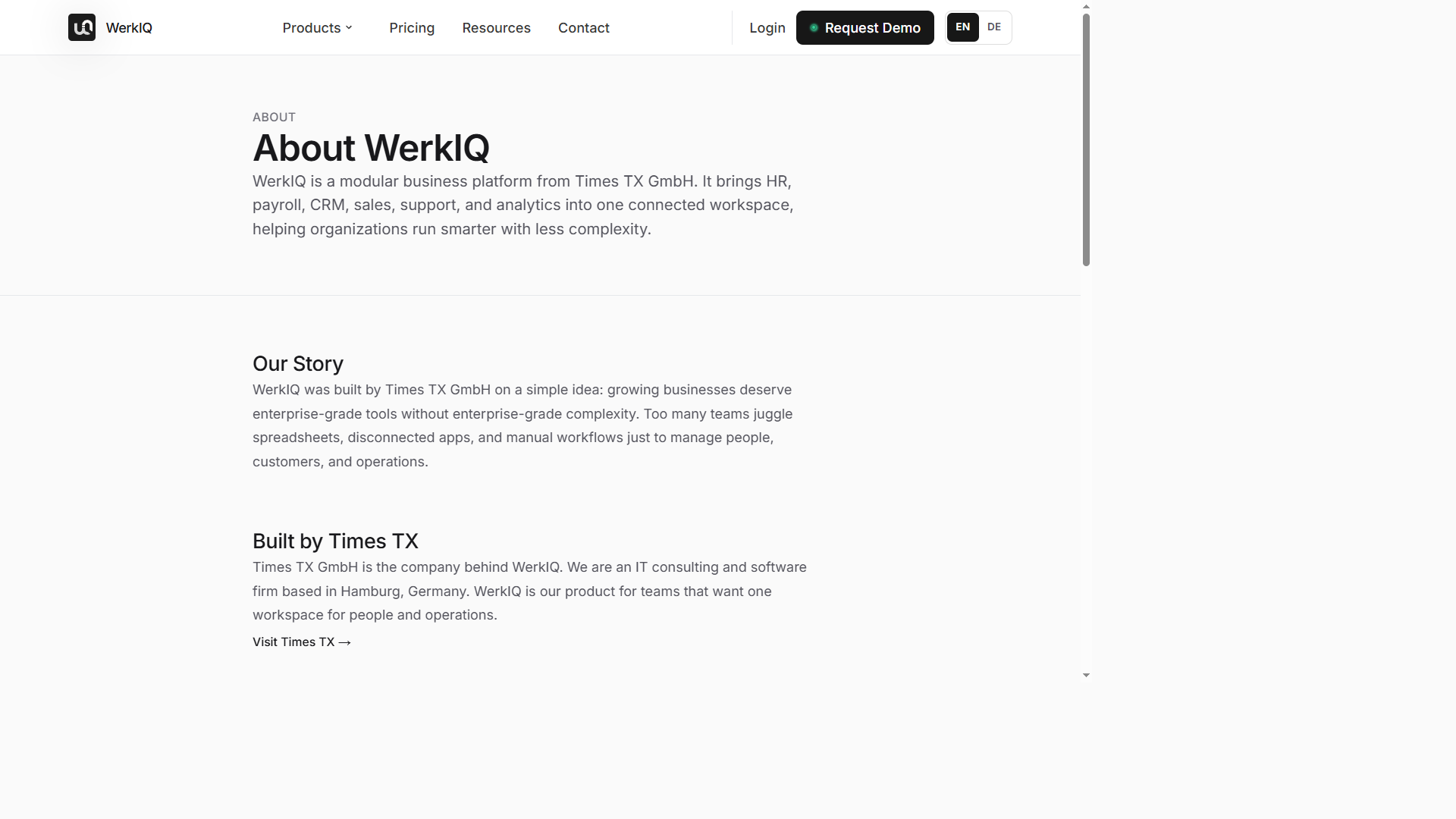
WerkIQ was aimed at growing and mid-sized organisations that want business software to be adopted in parts. Early teams and larger organisations were both kept in view. A start can be made with one area of work, and the same platform can be extended later.
The audience was defined by the work being done, and by the sector.
• People teams, for records, attendance, leave, payroll, and onboarding.
• Sales and account teams, for contacts, opportunities, and conversations.
• Finance and operations teams, for accounting, purchasing, stock, and production.
• Owners and managers who want one current picture of the business.
Eight industries were addressed with the same platform: healthcare, professional services, education, retail and hospitality, technology, manufacturing, nonprofit, and financial services. In each case, the workforce, the customers, and the operations of that sector were used as the way in.
The Platform
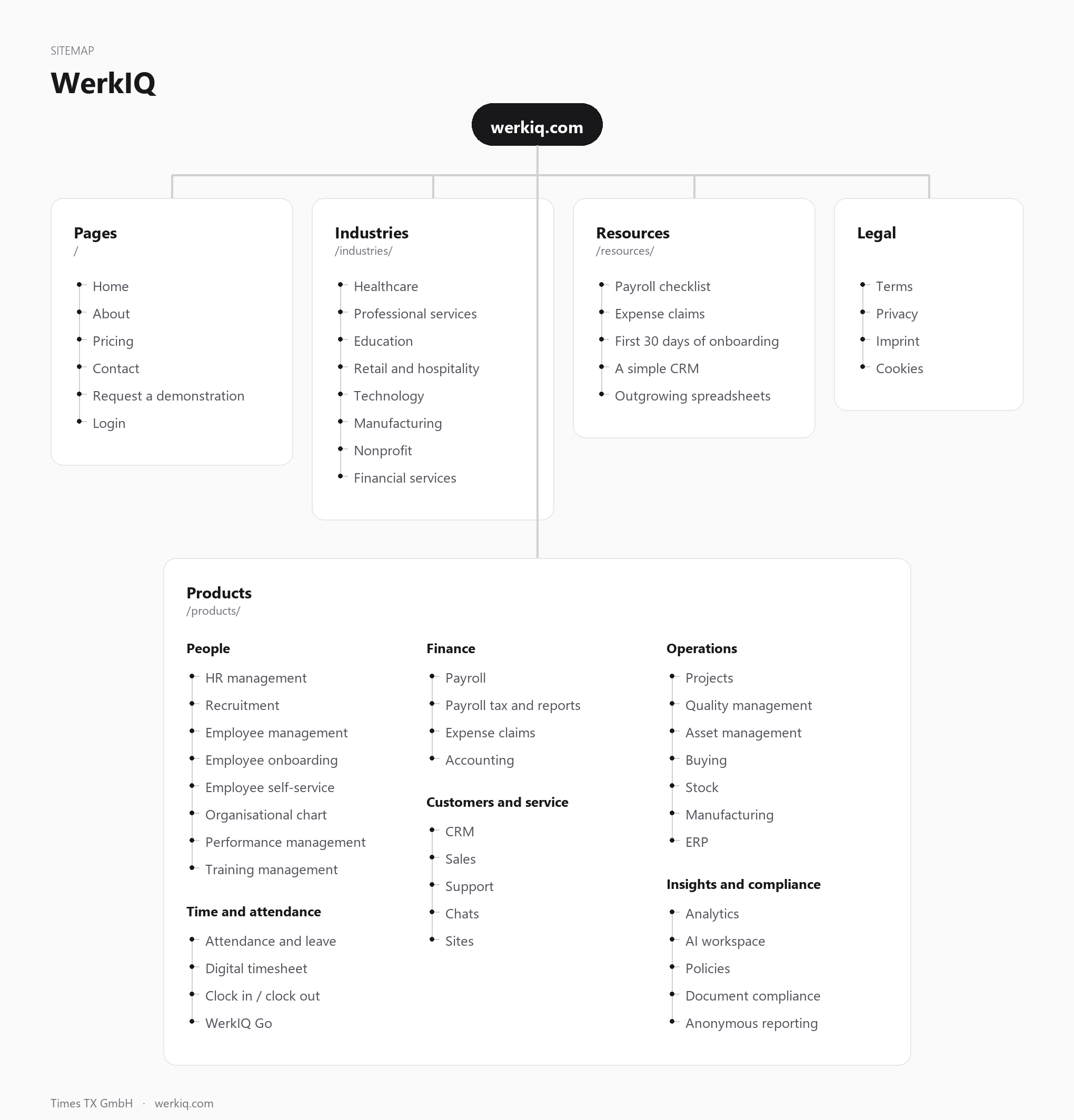
WerkIQ was organised as modules, grouped by the work they support.
• People: records, recruitment, onboarding, performance, the organisational chart, and training.
• Time and attendance: rosters, leave, timesheets, clock-in and clock-out, self-service, and WerkIQ Go.
• Finance: payroll, payroll reports, expense claims, and accounting.
• Customers and service: CRM, sales, support, chats, and Sites for the organisation’s own pages.
• Operations: projects, quality, assets, buying, stock, manufacturing, and ERP.
• Insights and compliance: analytics, the AI workspace, policies, document compliance, and anonymous reporting..
Hosting, sign-in, role-based access, updates, and support were included with the subscription. Migration, integrations, training, and custom development can be added when they are required. Other systems can be connected through APIs, webhooks, single sign-on, or a scoped project.
The Challenge
The range of the platform is part of its value, and it is also what makes a first explanation difficult. One question may be brought to the site: attendance and payroll, a sales pipeline, purchasing and stock, or a broader wish to replace existing tools step by step.
Placed on a single page, the full list of modules would name everything and clarify very little. Separate paths had to be kept open, the breadth of WerkIQ had to stay visible, and a next step had to stay obvious: a product page, a price, or a demonstration. The same journey had to work in English and in German.
Project Goals
The work was planned around six goals.
• The platform was to be explained through the work a business already does.
• A visit was to be able to begin with people, customers, operations, or finance.
• Each module was to be given its own page.
• Each industry was to be described through the same platform.
• Pricing was to be understandable before a sales conversation.
• A demonstration, contact, and login were to be easy to find in both languages.
How the Website Was Organised
The website was structured around the questions that might be brought to it. On the home page, WerkIQ was introduced as one place for people, customers, finance, and operations. Four consequences were set out: repetitive work can be reduced, decisions can be made from shared information, teams can work in one platform, and a beginning can be made with one area of the product.
The offer was then divided into four areas. Under people, HR management was offered. Under customers, CRM was offered. Under operations, projects, quality, ERP, and the AI workspace were offered. Under finance, accounting, purchasing, stock, and manufacturing were connected. Each area was closed with a route into the relevant product.
The Path Through the Website
A single sequence was laid through the site.
Understand the platform → Begin with an area of work → Open a module → Estimate the price → Request a demonstration
The platform is explained first. A start can then be made from people, customers, operations, or finance. The detail of a module is held on its own page. The cost is made readable on the pricing page. A conversation with Times TX can be requested when a closer look is wanted.
Sitemap
The public site was given a fixed set of routes. The same addresses are used in English and in German. The language is switched on the page. The address stays the same in both languages
Branding
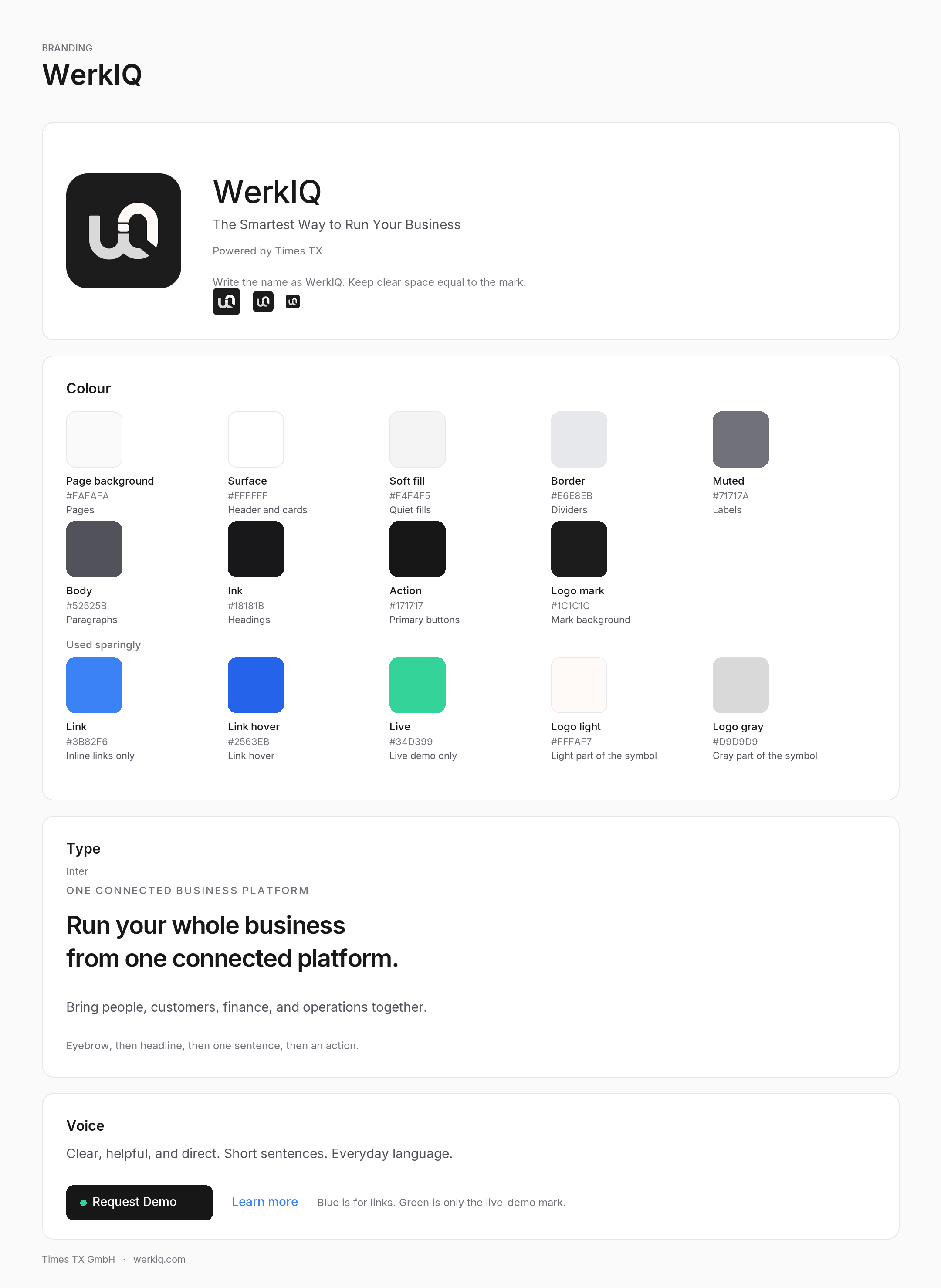
The name is always written WerkIQ, with a capital W and a capital IQ. The published line is “WerkIQ: The Smartest Way to Run Your Business.” In the footer, “Powered by Times TX” is used.
The mark is a geometric symbol on a dark rounded square. On the website it sits beside the wordmark. It is kept clear of other elements, and it is left unstretched and unrecoloured. The wordmark and all interface text were set in Inter.
The voice was kept clear and direct. Short sentences were preferred. A page follows one rhythm: a short label, a headline, one supporting sentence, and an action. Blue was reserved for links. Green was reserved for the live-demonstration indicator. The rest of the interface was kept to black, white, and soft gray.
Outcome
WerkIQ was delivered as a modular business platform. werkiq.com was delivered as the website through which that platform can be examined.
A visit can begin with people, customers, operations, or finance. From any of those starting points, a product page, an industry page, a price estimate, or a demonstration can be reached. The same path was provided in English and in German. What was delivered is a public starting point for the product, from which a conversation with Times TX can be requested when a closer look is needed.